


It was a warm summer evening in Bangalore, India. I was there on a work visit and decided to go for dinner with my gang of youthful friends. I ended up ordering the wine they had which was from a local vineyard not too far from Bangalore in Nandi Hills. The gentleman who poured a sample was very excited that I had ordered a local wine. But when I had taken my first sip, I felt it so harsh that I had to abandon continuing with it. For all that, I was actually a non-taster by test. This means that I am one of those who have a genetic predisposition not to taste bitterness much. This made me wonder if this was because the wine was produced in the tropics. What makes wine so special that it matters where it is grown?
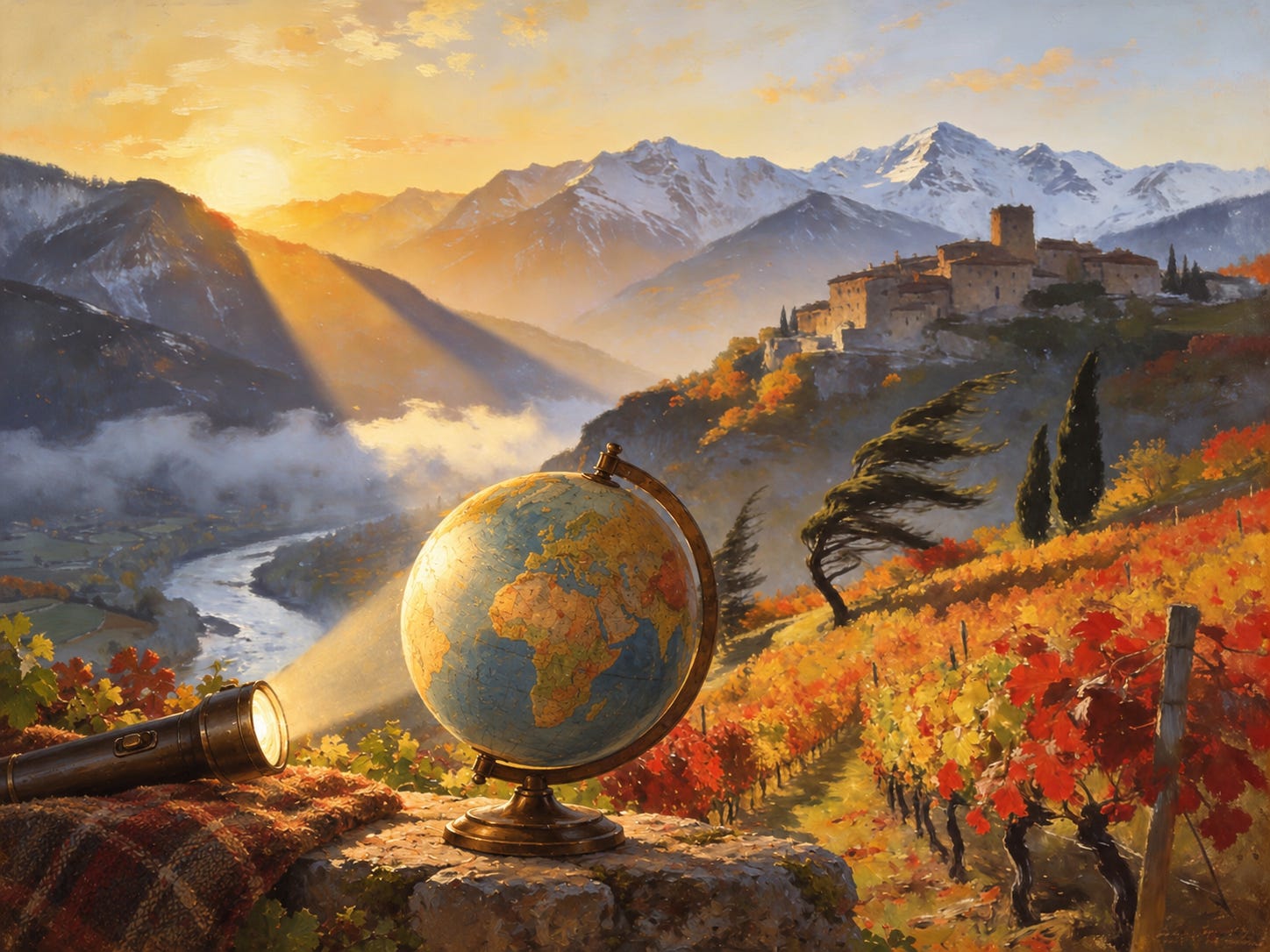
Sunlight travels 150 million kilometers before it strikes the surface of earth. It is the source of energy for almost all living forms on earth. Plants are the ones harvesting that energy first through the process called photosynthesis. So do the vines that bear grapes. The vineyards and the grapes occupy a narrow band on the earth in both hemispheres. It is the zone between 30 and 50 degrees latitude north and south. To understand why, we need a flashlight and a school globe of earth.
You must have noticed that the desk earth globe shows the earth on a tilted axis. This very axis is the reason for our seasons. And the reason we have the variations that we experience at any given latitude during the seasons is the angle at which the sunlight hits the surface of the earth. Depending on your latitude, the sunlight hits you at different angles. Let us do an experiment with our desk earth globe. First we will turn the lights off in the room. We now cast the light from our flashlight onto the globe. You will notice that the bright circle of light emanating from the flashlight stretches into a dim oval. The brightness now varies based on the angle it hits the globe.
Let us consider where we are right now on earth. Even though we are on flat ground, from a perspective of the angle at which sunlight strikes us, we are on an incline. Take me, in Phoenix for example. Phoenix sits at about 33 degrees north latitude, so the flat ground I am standing on is actually tilted 33 degrees. For the sunlight that is hitting me, I am on a 33 degree hill.
Flat ground is actually an incline.
Mendoza region in Argentina is around the same latitude but on the opposite hemisphere. Mendoza produces wine but Phoenix does not. It is considered a cold desert with a similar rainfall pattern to Phoenix. But Mendoza sits at 3000 feet above sea level which adds the additional lever in lowering temperature. There is also a marginal effect from more light getting through the thinner atmosphere. In addition, the Andes provide cool winds and reliable water. All of these, with elevation being the major lever, help with the cultivation of grapes in this region.
The incline is needed but not sufficient.
Now, let us move to the upper middle of the wine belt in the old world wine growing region, Hermitage, Rhone Valley in France. Hermitage is a prestigious wine growing area located at 45 degrees north rising above the river, Rhone. Hermitage is in all about 130 hectares on one south facing granite hill with flat land all around it. The slope allows not only maximal light exposure but also protection against the mighty wind from the northern Rhone, the Mistral. The wind itself has a lever of drying out the canopy that arrests any decay from moisture. Here the slope is the biggest lever with the wind providing secondary advantage. Surrounding Hermitage is Crozes-Hermitage, eight times its size and flatter, but selling wine at a fraction of the price.
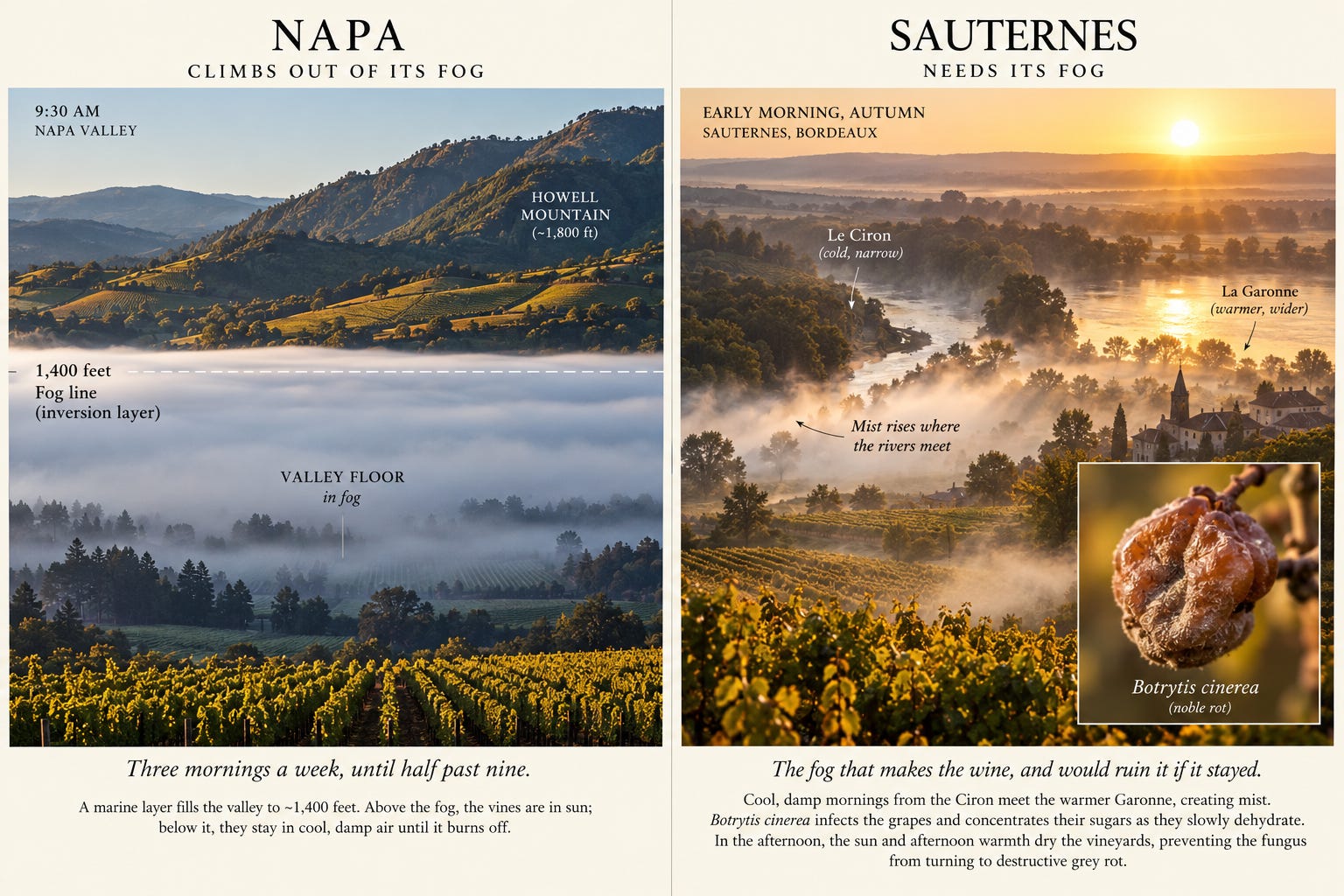
We now drift parallel to the west to the new world region, Napa valley, located at 38.3 north in California. Here the valley floor is heavily fogged three mornings a week until around half past nine during the growing season. Here you need an elevation of 1400 feet to be out of the fog layer. So all of the wine growing areas above that layer get warmer mornings and cooler afternoons along with less variation in temperature across day and night. The grapes ripen slower and later than on the floor. Elevation needs to be high enough to escape the fog.
Sauternes sits at the southwest edge of the Bordeaux growing region at 44.5 degrees north. The Ciron is a cold, spring fed river running into this warm zone. During autumn this creates morning fog which burns away into dry air by afternoons. The damp air establishes the fungus, Botrytis cinerea but the dry afternoon air prevents the rot. The fungus pierces the grape so fine that just the water evaporates concentrating the sugar up to 400g/l. The fungus also makes some compounds itself and leaves precursors which the yeasts convert during fermentation infusing flavors to this wine. My wife loves the Sauternes as she is a supertaster, the people who are genetically predisposed to be intolerant to bitterness. Here the fog makes my wife happy but it is a delicate balance. The same fungus with the wrong weather can rot the grape.
We have arrived here after we talked about incline, elevation, fog and wind. All of these can work outside of the belt as well. There are two major levers where the belt does have an upper hand. But when you combine the levers, the belt becomes the clear winner.
The first lever is the summer energy budget that gets allocated based on your latitude in summer. So let us start with allocation on one day in midsummer in the northern hemisphere and calculate how much energy is delivered at different latitudes. The equator gets the most concentrated light over the year and Tropic of Cancer has the sun directly overhead. Hence they should be getting the most energy delivered during midsummer. But that is where you have the surprise. Most of the belt beats both the equator and the Tropic of Cancer. The equator gets 20.8 megajoules per meter squared that day. Hermitage gets 26.1, a quarter more.
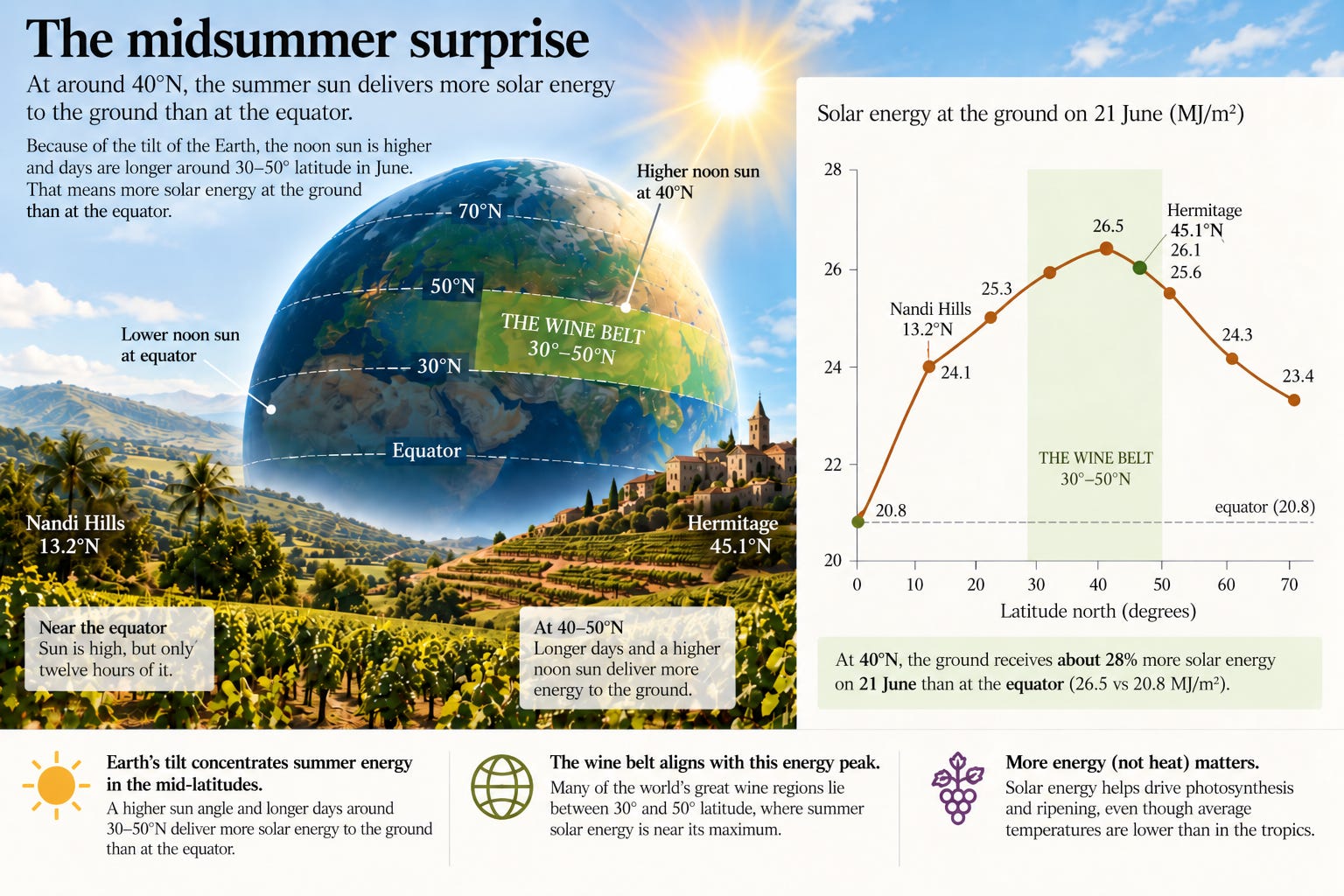
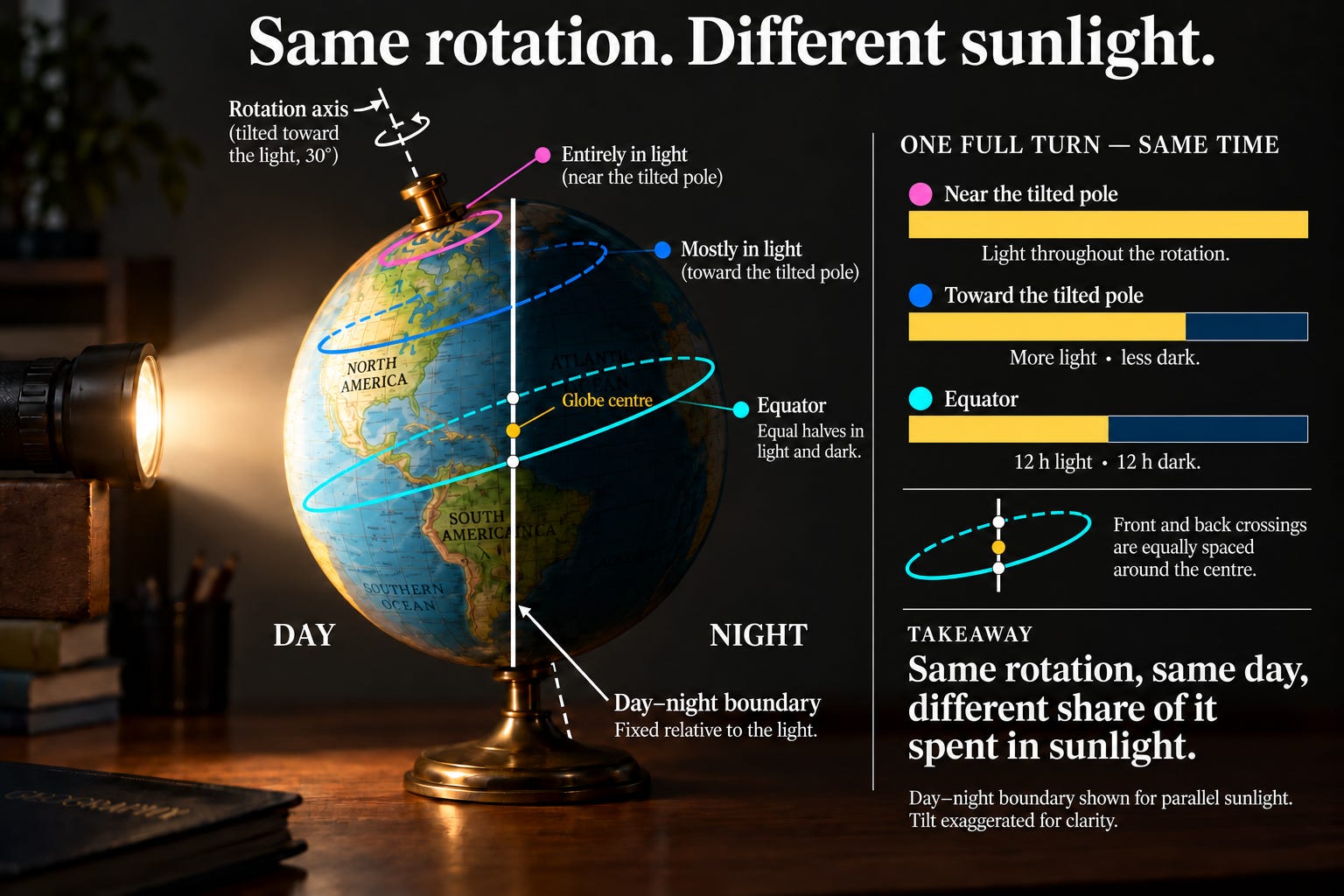
How is that possible? It is possible because the energy allocation is not just based on the angle at which the sun hits the latitude but for how long. During the summer the earth is tilted towards the sun. This is where we go back to the desk globe and the flashlight. The room should be made dark first. Let us start with shining the light straight with the northern hemisphere tilted towards the light and slowly spin the globe. You will see the upper latitudes stay in the light for longer and at the Arctic Circle it is all the time. The equator meanwhile receives the sunlight the same 12 hours regardless. And the Tropic of Cancer has the sun right over it in midsummer which gets it only 13 hours and 27 minutes of daylight compared to Hermitage which has 15 hours and 37 minutes.
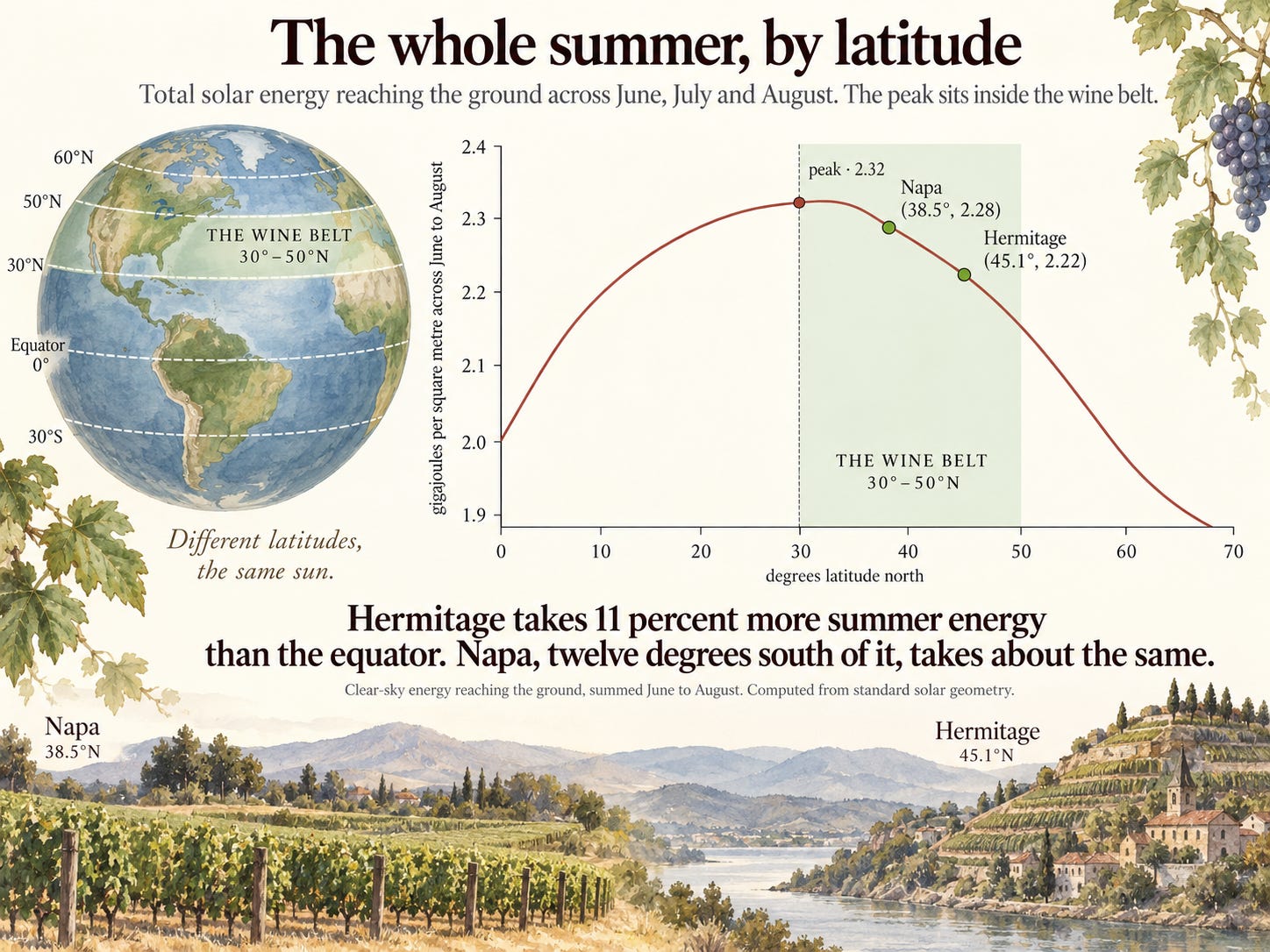
Now let us move to the entire summer energy budget. The total amount of energy that a certain latitude gets through the entire summer is measured in gigajoules per meter squared. Hermitage for example takes 11 percent more than the equator across the whole season. Napa gets slightly more. The peak occurs at 30 degrees north at 2.32 gigajoules per meter squared. Then it sort of holds steady from 30 to 45 degrees north around 2.28 after it starts its decline to 2.15 at 50 degrees north. Now, let us talk about how this is relevant to the grapes. The flowering starts around midsummer during which the cold and rain are the enemies. The warmth from all the energy harvested helps. The growth of the vine, its canopy, leaf surface and its entire machinery occurs mostly in summer and hence the energy advantage is key.
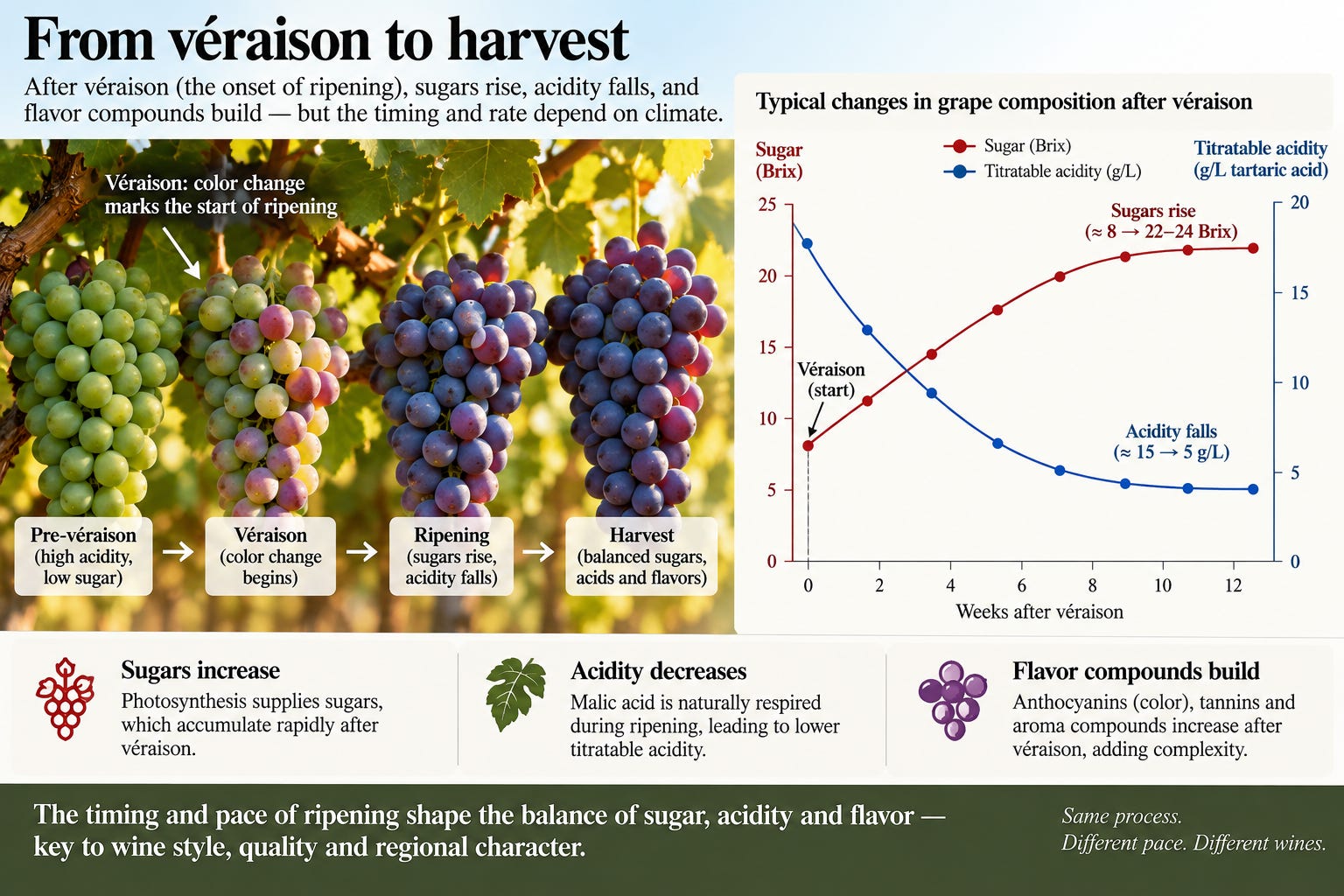
The next lever is the most important and it has to do with the timing of ripening of the fruit. End of July is the veraison. That is when the grapes lose their chlorophyll and gain the colors. The red grapes get their anthocyanin and gain purple and red colors. The white grapes lose their chlorophyll turning golden or translucent. The skin softens and sugars start rushing into them and their acid starts dropping as we get into fall. That is when the remarkable thing happens.
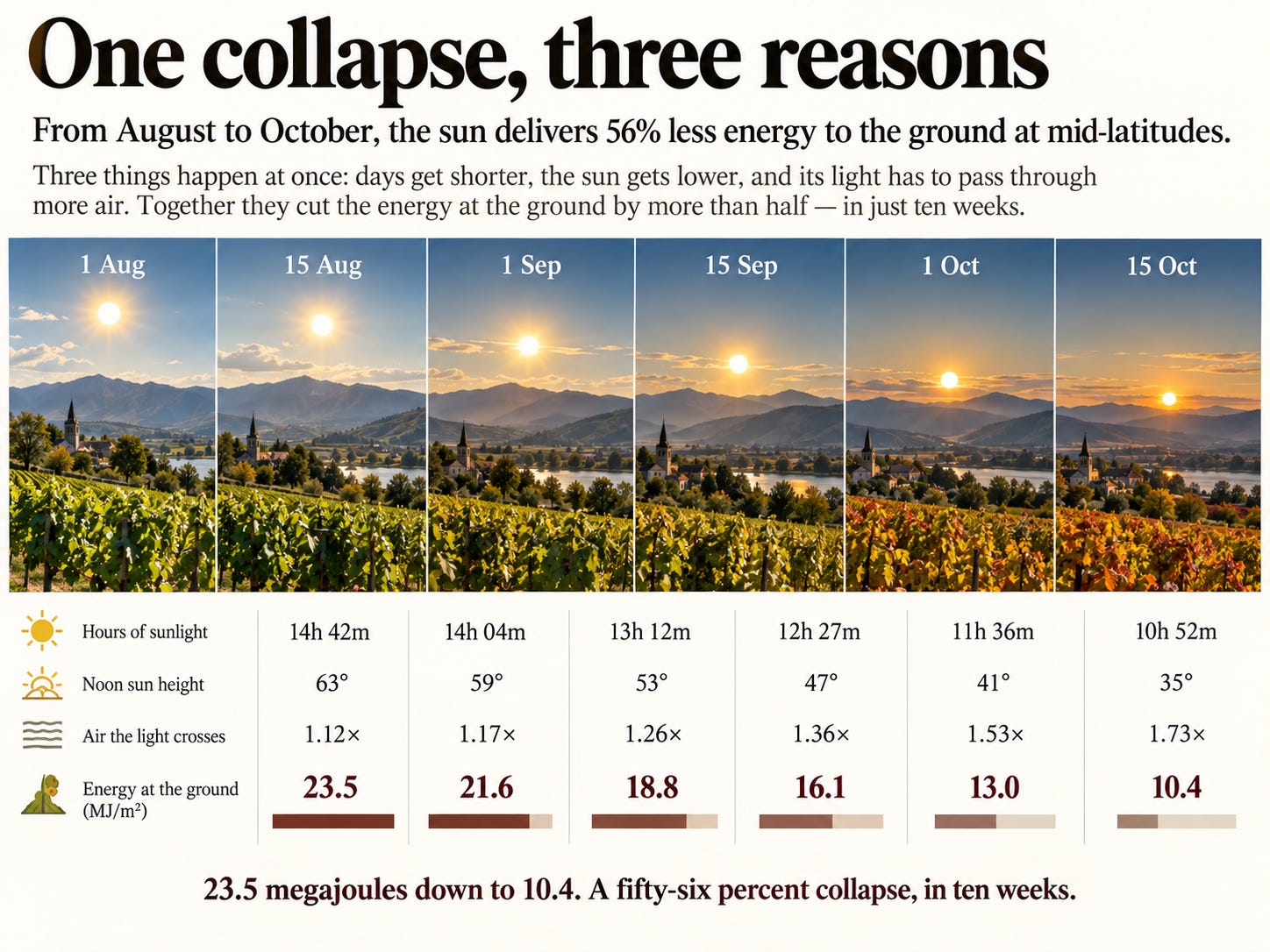
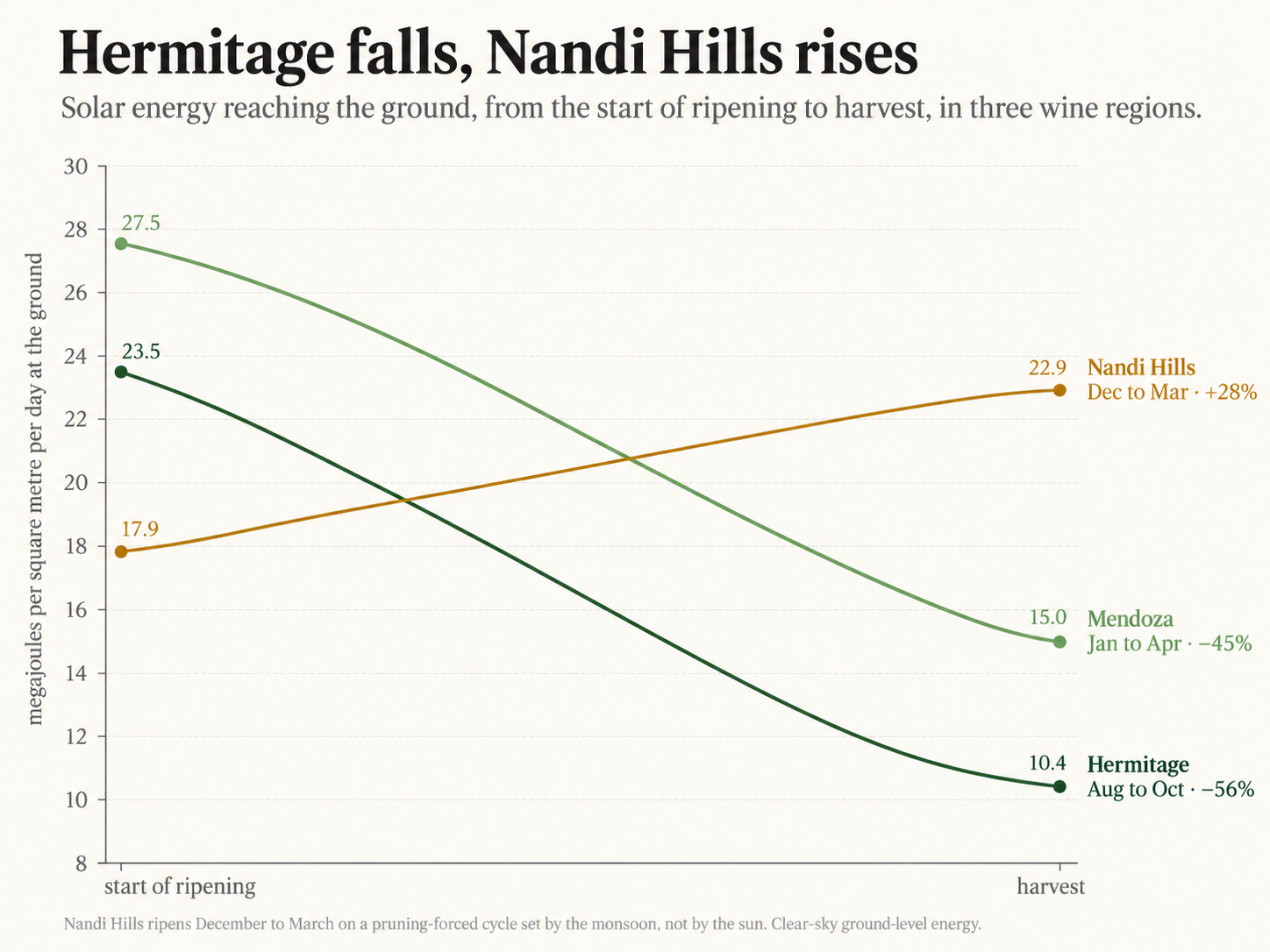
The energy from the sun drops dramatically as the earth’s tilt now is away from the sun and the days shorten due to it. This is the first layer of autumn collapse of energy. At Hermitage, the daylight goes from 14 hours 42 minutes to 10 hours 52 minutes from the first of August to the middle of October. The energy falls from 23.5 megajoules per meter squared per day on the first of August to 17.4 by the middle of October from the shorter day alone. That is a 26 percent collapse at about 1.2 megajoules per fortnight correlating with forty-five minutes of daylight every fortnight without a pause.
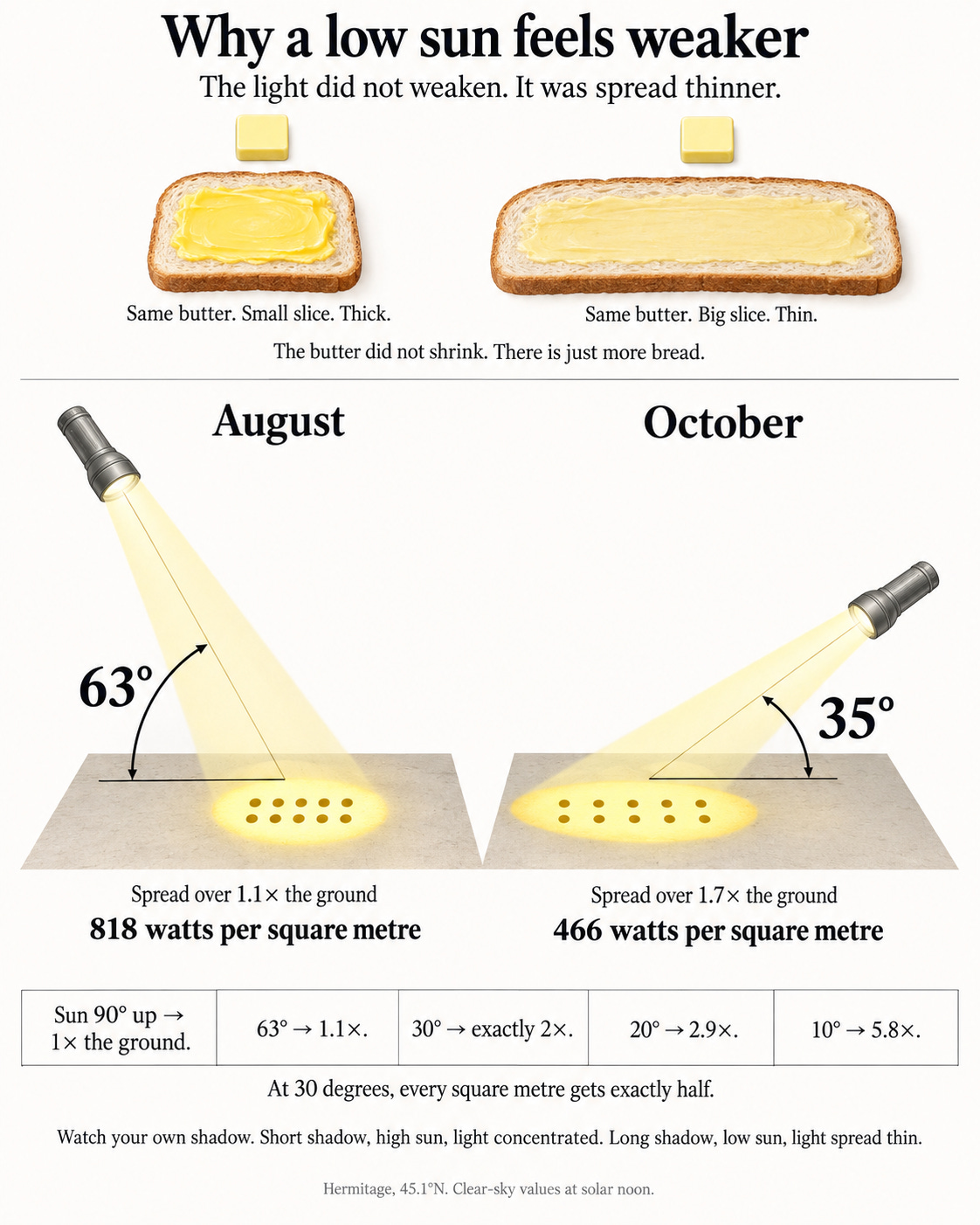
The second layer of autumn collapse comes from the sun being lower on the horizon with the tilt. To understand this we need to go back to the flashlight. When you focus the flashlight on the wall at an angle, you will see the beam of light spread over a larger area on the wall into a pale oval. Just like that with the tilt of the globe away from the light, the same beam of sunlight has to spread over a wider area reducing the intensity of light hitting each unit area of the ground. This causes further energy loss. At Hermitage, the noon sun, which is at 63 degrees on the first of August, goes down to 35 degrees in the middle of October. The same beam now covers 1.7 times the ground in October. From the energy that is left after the first layer of loss, the second layer takes it from 17.4 megajoules per meter squared to 11.3. That is an additional 6.1 megajoules which is about 35 percent at a rate of about 1.2 megajoules per fortnight.
The third and final layer of collapse happens due to the air. We have just discussed how the earth tilts away from the sun in autumn. Because of this the light now has to travel more through the atmosphere before it touches the surface. The air reduces the intensity of light essentially by scattering of light by air itself and the particles floating in it. Additionally there is also loss from absorption by water vapor, carbon dioxide and ozone. The loss is all across the light spectrum. So when the light eventually reaches the surface there is a decrease in the energy that was left after the first two layers, 11.3 megajoules to 10.4 megajoules per meter squared at Hermitage between the first of August and the middle of October from the air alone. This is a loss of an additional 8 percent. The energy left after each stage was 0.74 then 0.65 followed by 0.92 of what came before. Multiplying them 0.74 x 0.65 x 0.92, we get a total of only 44 percent that is left, which amounts to a 56 percent loss from all the three layers of autumn collapse.
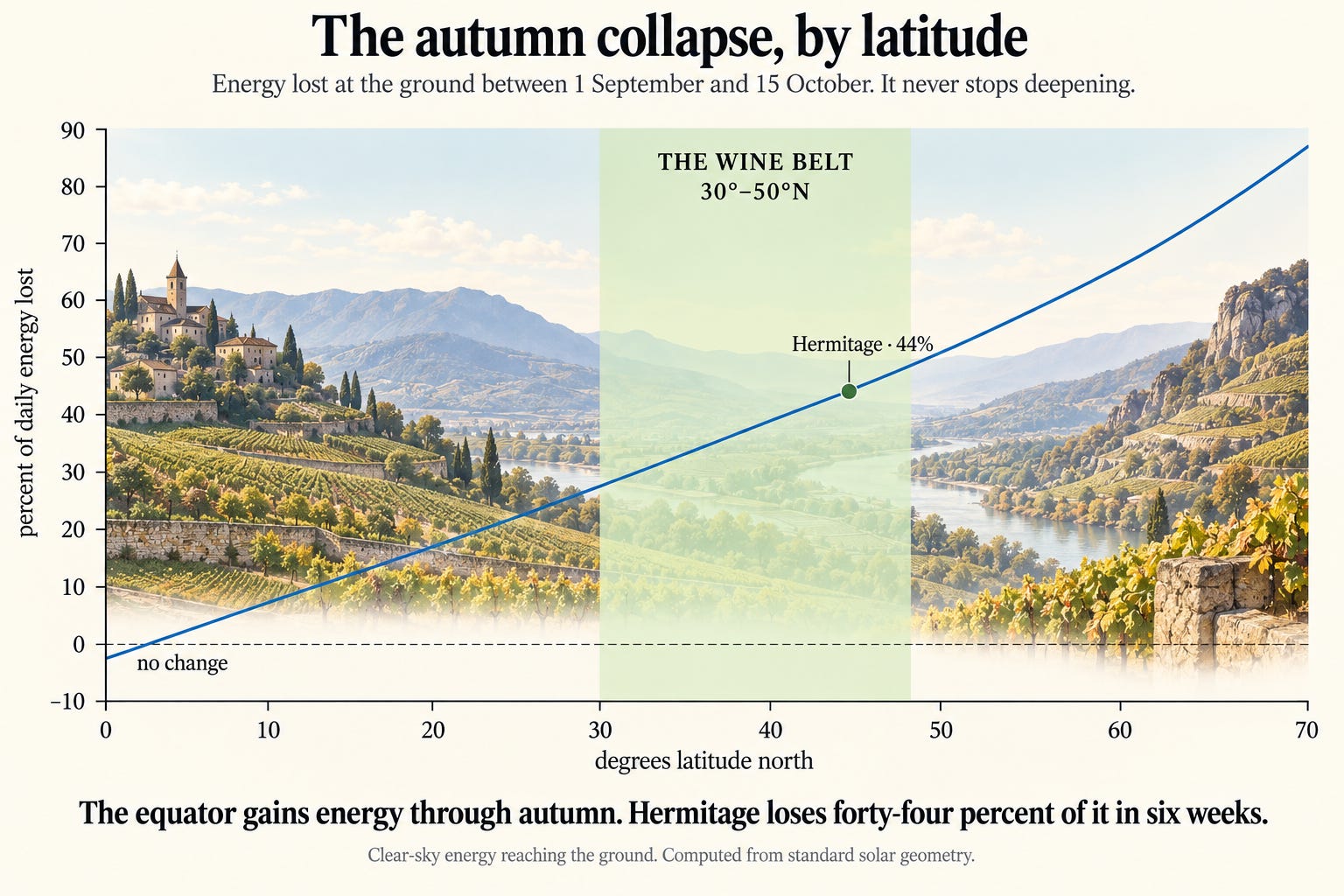
All these layers of autumn collapse do a huge favor to the grapes and more so for the wine makers. It slows down the sugar from a race to a creep. The cold nights stop the acid from burning off. Skin color matures, tannins soften and aromas start developing. It is almost as if the autumn collapse puts the grape maturity in slow motion. Sugars build slowly so they accumulate peaking at harvest. The acid burn off comes to a stop and will come in handy for preserving wine later. The character of the grape builds in the color and flavors.
This is the effect of the geometry of Earth’s tilt, sunlight and air.
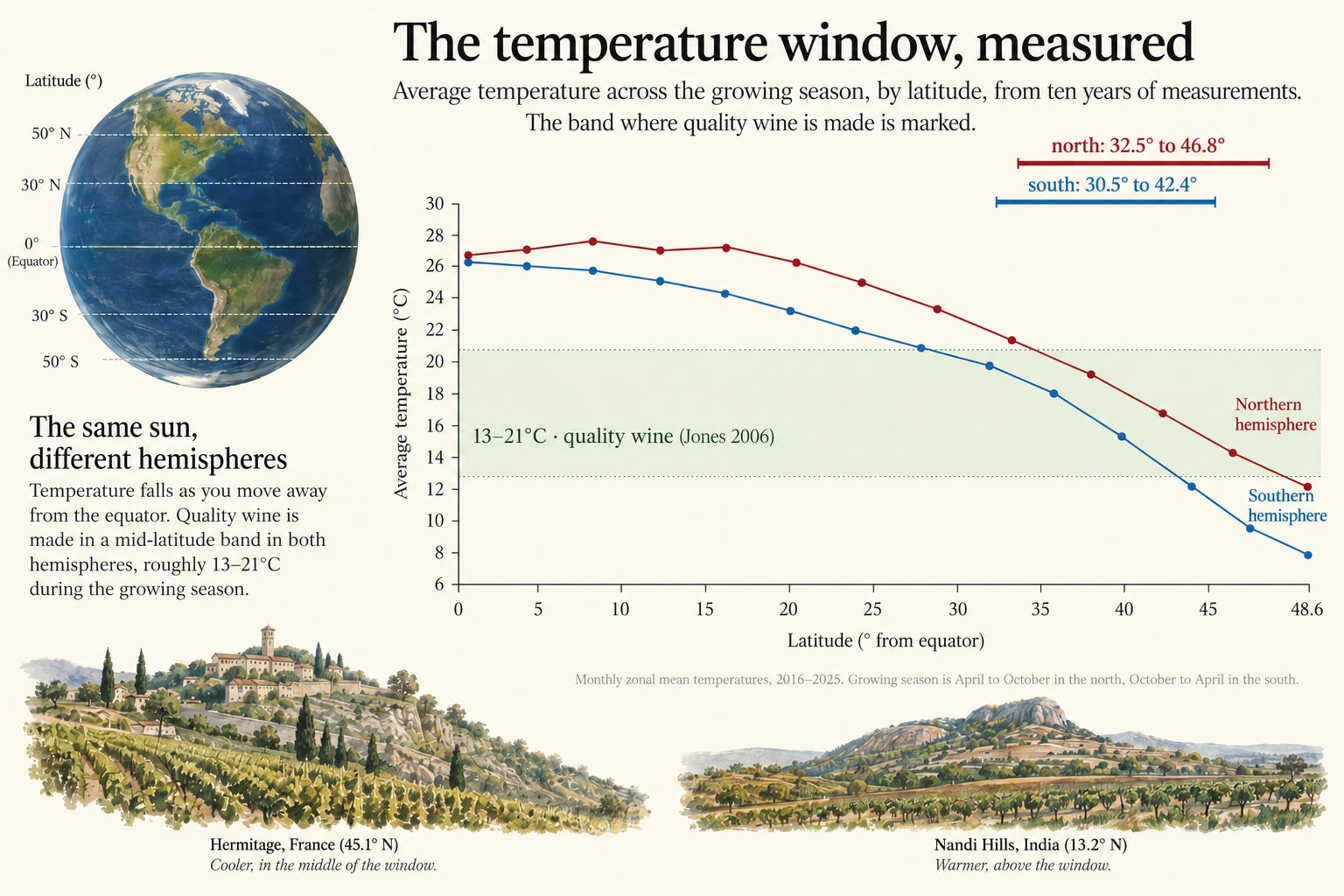
There is one other factor that plays an important role in the viability of a wine growing region. It is the temperature window during the wine growing season. This is not fixed by latitude alone. For example Bordeaux and Mongolia are sitting at the same latitude with the same light and angles. What separates them is heat and heat comes from ocean, altitude and how far inland you are. Jones in 2006 determined that quality wines come from places whose growing season average sits between 13 and 21 degrees Celsius. On measured temperatures from 2016 to 2025, the 13 to 21 window runs from 32.5 to 46.8 degrees north and 30.5 to 42.4 degrees south. The temperature window then falls within the belt where light is already doing the right work with the two major levers. Every serious region sits inside this temperature zone and every one that sits outside and some that are sitting inside have other levers helping them.
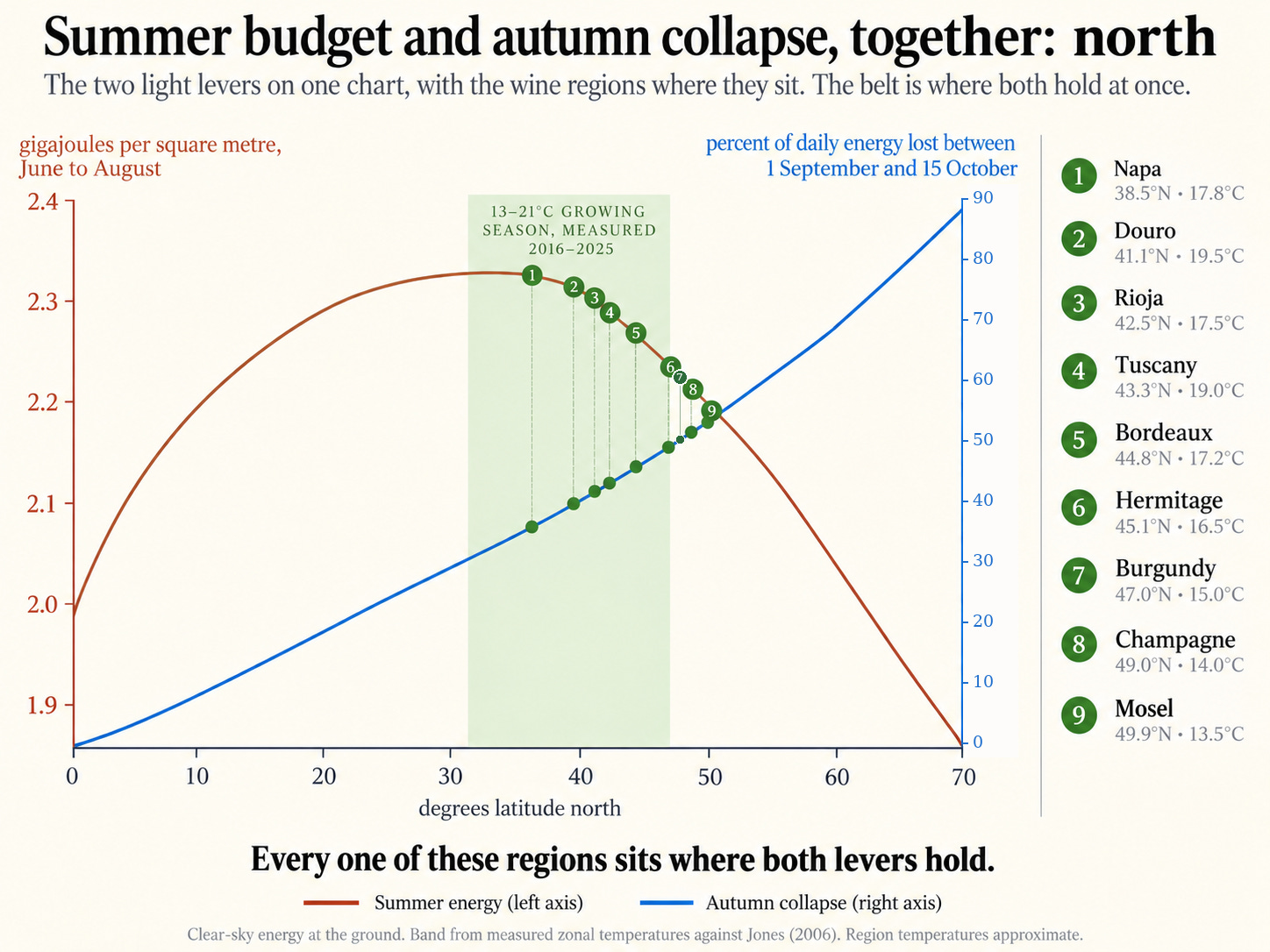
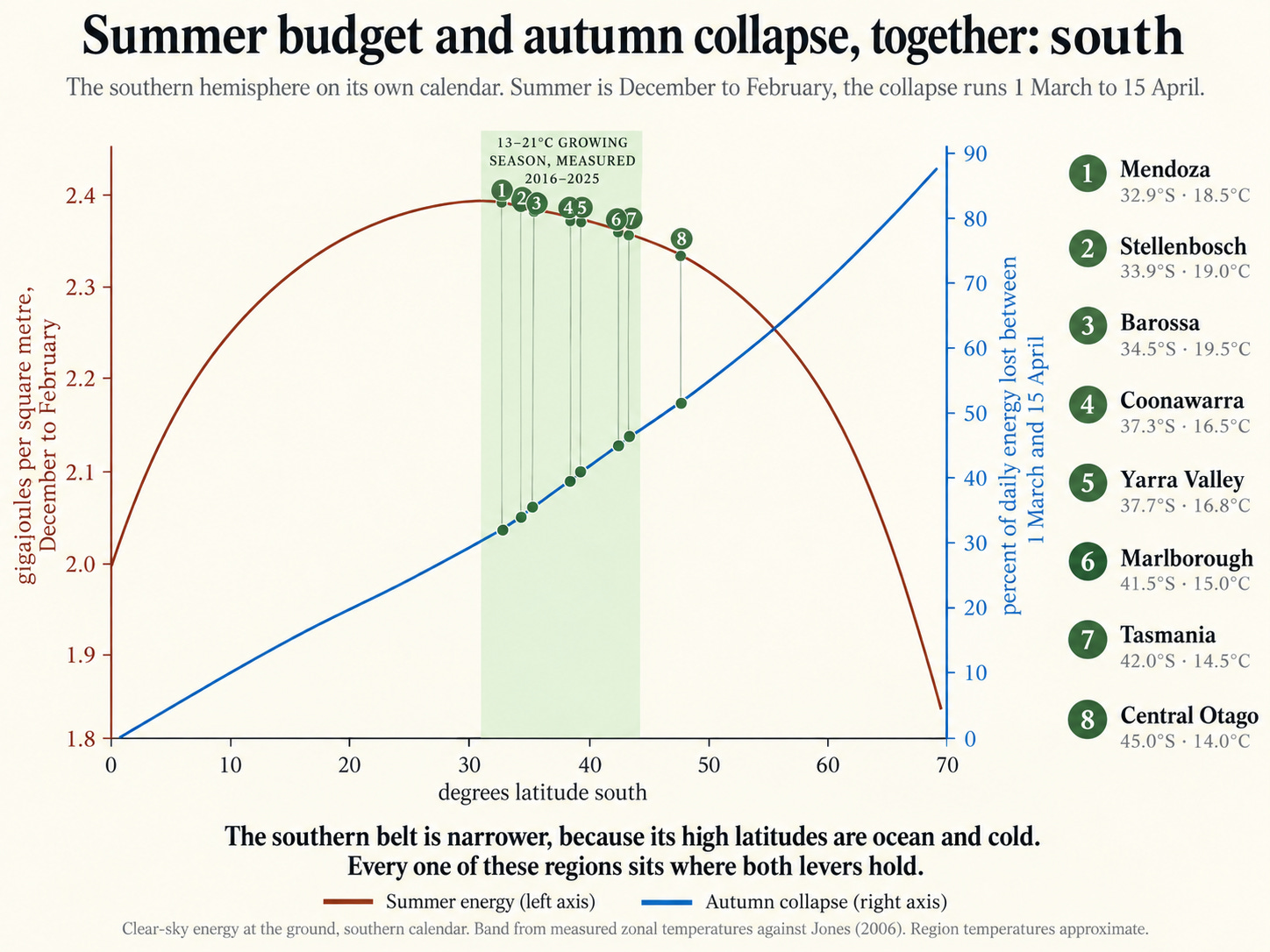
Now it is time to answer our original question. Let us travel back to Nandi Hills which is at 13.2 degrees north and 45 kilometers from Bangalore. We just talked about the two big levers in wine that no one chose but were endowed: the summer budget and the autumn collapse. Nandi Hills gets exactly the same summer energy as Hermitage, 2.22 gigajoules per meter squared. Before we get to the collapse we need to talk about the one major adjustment by hand that Nandi Hills had to do. It had to change the growing season entirely due to the monsoon. The vine does not stop as the sun does not tell it to. So the vine is pruned to force a new start. The season now changed by hand at Nandi Hills runs from December to the middle of March. So the entire summer budget we talked about earlier becomes irrelevant. The difference is entirely in the collapse. Hermitage loses fifty six percent across its ripening. Nandi Hills gains twenty eight percent across its own, rising from 17.9 megajoules a day in December to 22.9 by the middle of March. In Nandi Hills, the days do not shorten, the sun does not drop toward the horizon and the air path of the sunlight does not lengthen. The grape ripens under the sun which never withdraws. They are forced to pick when the sugar is ready but the fruit is not. The acid burns off too. The pigments and the flavors do not get enough time to mature. It is an uphill battle for the wine makers here. Some of the defects are structurally built in due to the latitude. So the margin for error is negligible. No one chose these levers and the belt was not chosen either. The places that are in the belt got the summer budget and the autumn brake.
Everywhere else you have to build all that by hand.
In 1855, Napoleon wanted France’s produce shown in the Exposition Universelle. He specifically asked Bordeaux Chamber of Commerce to arrange for a wine exhibit there. The method that was used was ranking by average trade price over the previous forty years. Bordeaux sits inside the summer energy and autumn collapse belt. The brokers got it right by price and what sold. But Burgundy was refused even though it sits inside the same band.
The scaffold drew the boundary based on administrative power not based on what was grown on the ground.
This very wine belt is not a fixed entity. It has started to move. The two big levers we talked about do not move. The temperature band which decides who can grow is moving and it is because of climate change. Harvest in most of the wine growing regions is happening two to three weeks earlier compared to forty years ago. France’s harvest has moved by 24 days. A review done by van Leeuwen in 2024 finds that if global warming increases by 2 degrees Celsius, 90 percent of winegrowers in coastal regions and plains of Spain, Italy, Greece and southern California will no longer be viable at the end of the century. The winners appear to be northern France, Washington, Oregon, British Columbia, Tasmania along with new entries in Belgium, the Netherlands and Denmark. That temperature line is moving toward latitudes that have a steeper autumn collapse. The heat window is going to be a dominant player in the future.
Climate change has now created a new frontier for wine growing. This includes Hokkaido at 43 degrees, Tasmania at 42, Patagonia at 45, northern France at 50, Poland at 52, Denmark at 55. The same summer light as Bordeaux and a steeper autumn collapse. They were always within the wine belt. What kept them out was the temperature and the scaffold. Climate change is fixing the temperature.
The scaffold, where the control sits, has not moved.
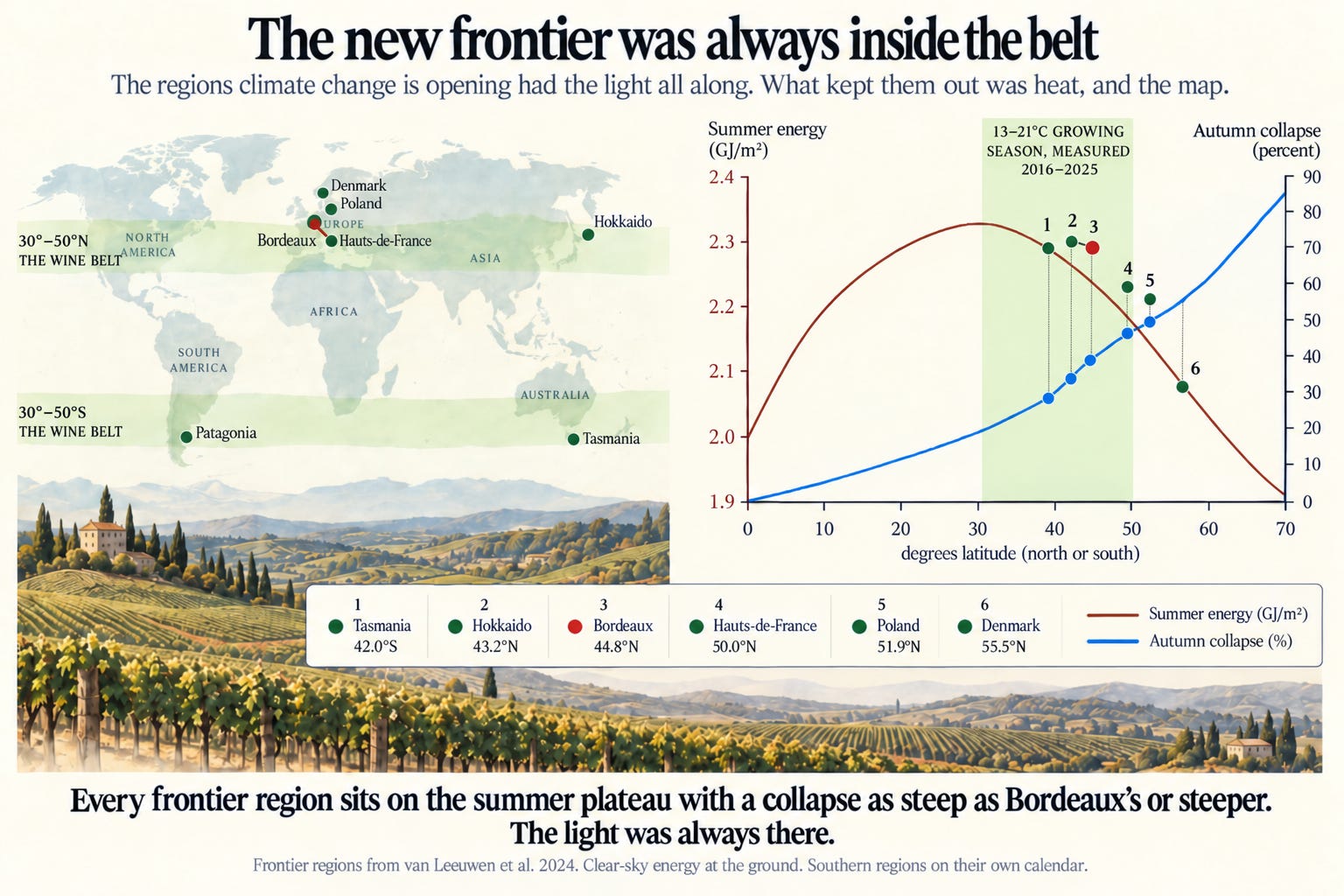
The appellation needs a meritocratic upgrade and that too by physics. Science provides us a factual basis to open the gate away from the whimsical gatekeepers. 1855 ranked just what one port could see but physics admits both hemispheres. A classification drawn from the band where summer holds and the collapse runs the right way starts with what grows there not who is in the room. It has limitations as well. It can only admit places but cannot guarantee them. Nova Scotia has the light and the brake running the right way but the spring frost is the costly risk.
Physics is an honest gatekeeper. It says where the ground is right but cannot say if it is worth a name. The naming rights should belong to the folks who consume the wine. That would be the right stack. Next in the series we will explore what was actually chosen, the vine, the rootstock and the fruit.
Next, why the grape was the fruit that made it. Read Demystifying Wine, Part 2, The Vine, the Fruit and the Root.
Sources
Earth to Sun mean distance, 149.6 million km. Standard reference.
Latitudes: Phoenix 33.45°N, Mendoza 32.89°S, Hermitage 45.09°N, Napa 38.30°N, Sauternes 44.5°N, Bengaluru 12.97°N. Standard gazetteer values.
Day length at 45°N (15h37m and 8h46m), Tropic of Cancer (13h27m), equator (12h07m): timeanddate.com day length tables; Wikipedia, “Daytime.”
All insolation figures (megajoules and gigajoules per square metre, the collapse percentages, the three layers, the belt curves) are computed from standard solar geometry per Duffie, J.A. and Beckman, W.A., Solar Engineering of Thermal Processes, with clear sky atmospheric transmission per Meinel, A.B. and Meinel, M.P. (1976), Applied Solar Energy.
Mendoza: cold desert climate, under 9 inches of annual rain, around 70 percent of Argentine wine, vineyards near 3,000 feet. Wikipedia, “Mendoza Province” and “Mendoza wine.”
Hermitage: single south facing granite hill, 344 m, about 130 hectares; Crozes-Hermitage about 1,032 hectares; the Mistral from the north. Wikipedia, “Hermitage AOC” and “Crozes-Hermitage AOC”; Wine-Searcher regional pages.
Napa fog: inversion layer near 1,400 feet; Howell Mountain AVA (1983) defined above the fog line; valley floor fogged about three mornings a week until about 9:30. Napa Valley Vintners; Howell Mountain Vintners and Growers; TTB AVA documentation.
Sauternes: the Ciron meeting the Garonne; Botrytis cinerea; must up to about 400 g/L; glycerol and sotolon; preferential consumption of tartaric acid. Wikipedia, “Sauternes (wine)” and “Noble rot”; Wine Australia fact sheet on botrytis.
Grover Zampa, Nandi Hills: Doddaballapura, about 45 km from Bengaluru, 920 m, harvest January to March. Grover Zampa website.
Winkler growing degree day index, April 1 to October 31: Amerine, M.A. and Winkler, A.J. (1944), Hilgardia 15: 493 to 675.
Veraison at the end of July and flowering around midsummer near 45°N: Vintel viticulture guide and standard phenology references.
Malic acid is respired in the berry at a rate that rises with temperature; tartaric acid is stable. Sweetman, C., Sadras, V.O., Hancock, R.D., Soole, K.L. and Ford, C.M. (2014), “Metabolic effects of elevated temperature on organic acid degradation in ripening Vitis vinifera fruit,” Journal of Experimental Botany 65: 5975 to 5988. Plantevin, M. et al. (2024), “Characterization of varietal effects on the acidity and pH of grape berries for selection of varieties better adapted to climate change,” Frontiers in Plant Science 15: 1439114, DOI 10.3389/fpls.2024.1439114.
Jones, G.V. (2010), “Climate, Grapes, and Wine: Structure and Suitability in a Variable and Changing Climate,” VIII International Terroir Congress. The 12 to 22°C bound.
Jones, G.V. (2006), “Climate and Terroir: Impacts of Climate Variability and Change on Wine,” in Macqueen, R.W. and Meinert, L.D. (eds.), Fine Wine and Terroir: The Geoscience Perspective, Geoscience Canada Reprint Series 9, Geological Association of Canada, St. John’s, pp. 203 to 217. The 13 to 21°C quality band.
Zonal growing season temperatures 2016 to 2025: NOAA Physical Sciences Laboratory, NCEP-DOE AMIP-II Reanalysis (R-2), monthly mean 2 m air temperature. Zonal means calculated across longitude; growing season April to October in the north, October to April in the south. Kanamitsu, M., Ebisuzaki, W., Woollen, J., Yang, S.-K., Hnilo, J.J., Fiorino, M. and Potter, G.L. (2002), “NCEP-DOE AMIP-II Reanalysis (R-2),” Bulletin of the American Meteorological Society 83: 1631 to 1643, DOI 10.1175/BAMS-83-11-1631.
The 1855 classification: Bordeaux Wine Council, “The 1855 Classification”; Wikipedia, “Bordeaux Wine Official Classification of 1855.” Commissioned through the Bordeaux Chamber of Commerce for the Exposition Universelle; ranked by trading price; Burgundy refused; the right bank excluded.
van Leeuwen, C., Sgubin, G., Bois, B., Ollat, N., Swingedouw, D., Zito, S. and Gambetta, G.A. (2024), “Climate change impacts and adaptations of wine production,” Nature Reviews Earth and Environment 5: 258 to 275.
INRAE press release, March 2024, on the above.
France’s harvest about 24 days earlier; the 2026 heat; plantings in Normandy: France 24 reporting, September 2026.
Morales-Castilla, I., García de Cortázar-Atauri, I., Cook, B.I., Lacombe, T., Parker, A., van Leeuwen, C., Nicholas, K.A. and Wolkovich, E.M. (2020), “Diversity buffers winegrowing regions from climate change losses,” PNAS 117(6): 2864 to 2869, DOI 10.1073/pnas.1906731117.
Frontier regions: van Leeuwen et al. (2024) for the named winners and new entrants.
I liked the way you made terroir feel less mysterious by tracing it back to light, temperature, slope, fog, and timing. The contrast with Nandi Hills was especially interesting because it showed how much of a wine’s character begins with conditions no winemaker chose. “Physics is an honest gatekeeper” felt like a fitti