
Wine for Thought
On the train I did not know I had boarded, the stations of my senses through which the molecules travelled before a verdict, and the tracks that could shift that.

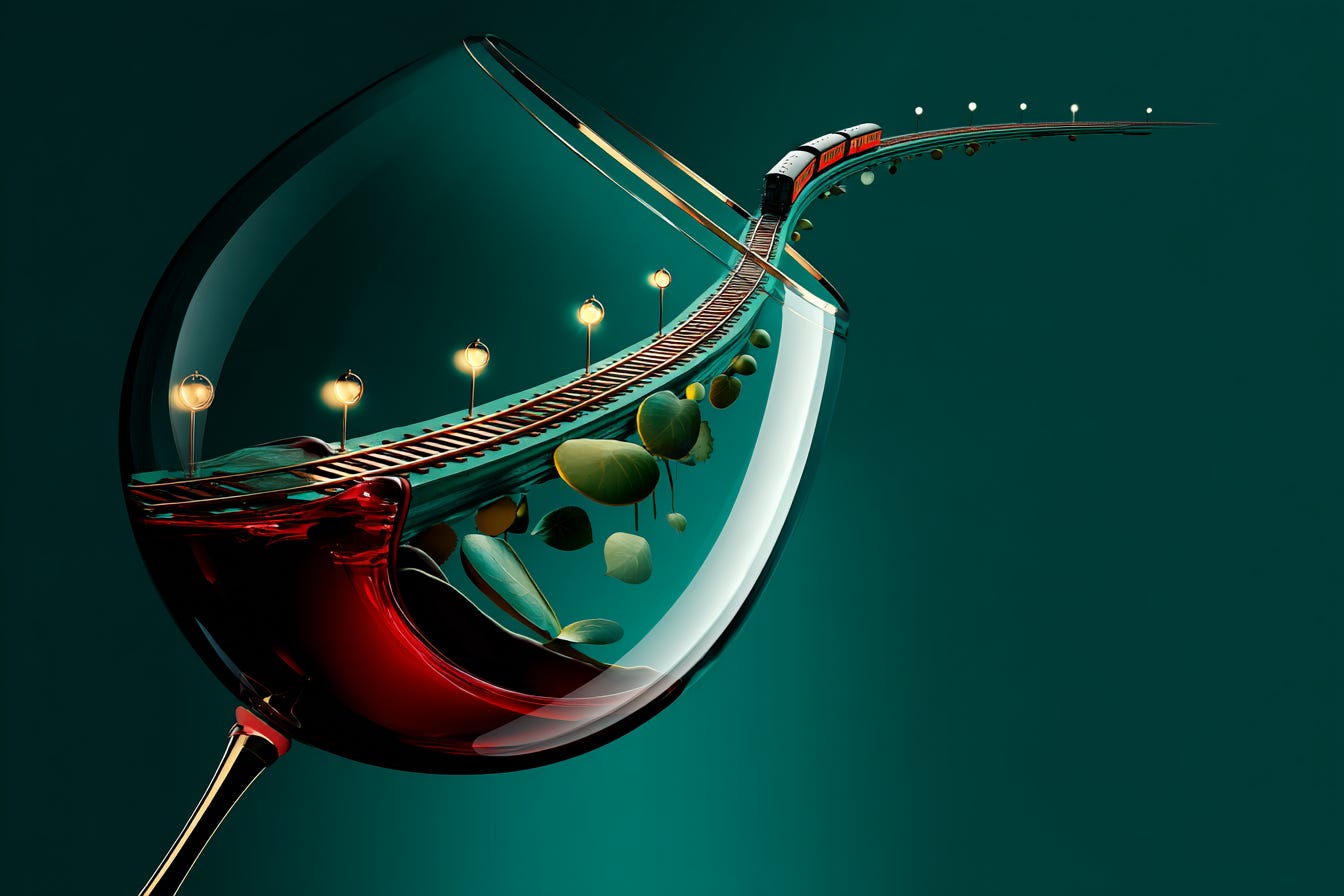
I have made many a career decision by moving through uncertainty until a clear path appears. But on that Friday evening, after a long week, a friend’s dinner invitation left me stranded in a wine store, caught in a fog I could not find my way through.
The invitation came with a rule, well-meant and clearly stated: do not bring just any wine, nothing off the bottom shelf, nothing under a certain price, and if you are not sure, bring nothing, we would honestly rather you did. A little blunt, I thought. But it’s their table, their call. And it should have been the easiest errand in the world because the fix looked obvious: stay above the floor they had set, and you should be safe. So, I stood in the aisle with my wife beside me, hunting for the bottle that cleared it, and could not find the place where below became above. I have always decided on wine at the table. Every label promised things I had no way to check. The price told one story and the words on the back told another and the rule I was trying to satisfy assumed a kind of seeing I did not have. We narrowed nothing. We left with nothing. We drove to their house with empty hands, which by the terms of their own rule, was a permitted answer, and somehow the permitted answer felt like the most exposed one of all. What was their bottom shelf and was price a reliable way to get to the top floor?
I had wanted to understand wine for a long time, not to perform it, but to truly grasp it, the way you want to understand anything intelligent people treat as obviously meaningful while you stand at the edge of the glass, nodding and hoping the nod is enough. For years, it sat on my list of things to learn. That aisle was where the bill came due.
The scientific rigor in me and the skeptic that I was did not make it easy. And more than once I have been tempted to settle it the cheap way, to decide the whole thing is theater and walk off lighter. The exit was always right there. But something kept stopping me, and it was not manners. It was the people. The ones who believe in this are some of the most reasonable people I know, and reasonable people do not pour decades of attention and real money into nothing. And underneath them, the longer fact: culture does not keep things alive out of sentiment. Whatever survives this long survives because it is doing some kind of work, even when the people doing the work cannot tell you what the work is. So, the contempt never closed the deal. There was something in the glass I had not found, and walking away would only have meant I stopped looking before I found it.
So I went and took it apart instead. And what I got sucked into was an entire journey within myself: a line the wine travels from the moment it is a molecule to the moment I pronounce a verdict over it, and a string of stations along the way, each one adding something the station before it did not have. I had been standing on a platform my whole life mistaking it for the ground. The first station, the one nearest the front, is the one that should have shown me the rule itself was the problem, not me, not the wine.
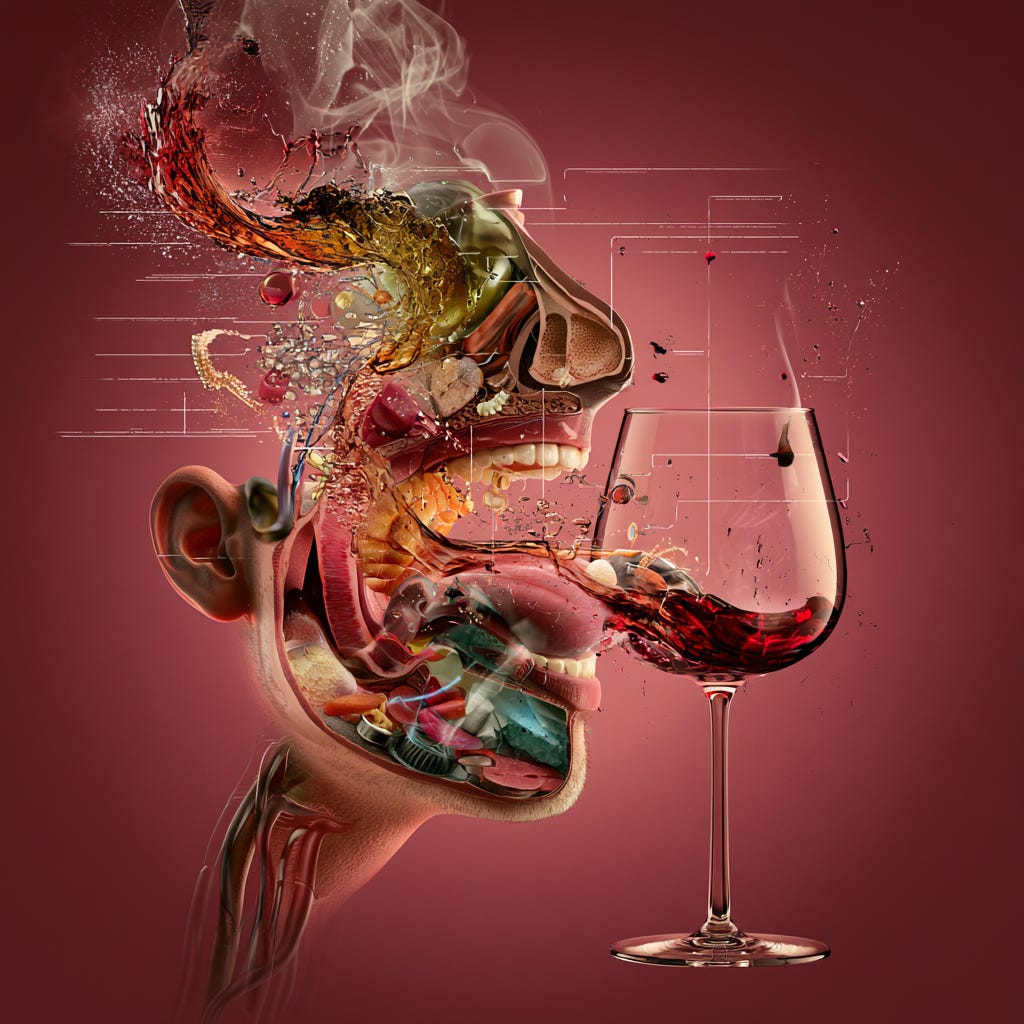
I board the first station swirling, sipping, and holding a mouthful with the glass still in my hand, thinking the tongue is where the wine is being read. The tongue does not and cannot taste the flavors of wine. The tongue is a blunt instrument, and this is not a figure of speech, it is anatomy. Sweet, sour, salt, bitter, and the savory one we had no word for until we borrowed umami. That is the working range of the human tongue, five notes, maybe a sixth if you are generous about fat. It does its part at this station, but is small and gives a structure for the journey. It catches the sourness (the acidity a taster means by crisp, or bright, or racy) and that spine is real, on the tongue. It catches sweetness when the yeast leaves sugar behind. It catches a low hum of the savory in wines that have aged or rested on their lees. And that is nearly the whole of it. But those few notes have to agree, and when they do, that agreement is the spine holding, the balance the rest of the journey is built on. Everything else, every word that has ever made wine sound like poetry, is happening somewhere other than the tongue. Blackberry. Graphite. Saddle leather. Crushed violets. Wet stone. None of it is taste. It is smell: aroma climbing the back of the throat into the nose while you hand the credit to the tongue, laid over memory, laid over a vocabulary that arrives a half-second behind the sensation and tells it what it was. The sommelier swirling and pronouncing is not reading her tongue. She is reading her nose, and her nose is wearing the tongue’s name, because the tongue is the part that touches the wine and gets billed for it.
I knew this in the store. That is the part I keep returning to. I am not usually frightened by a sophistication I do not possess. It only makes me curious. I had read enough to know that tongue is a courtesy title, that the friend whose table we were driving toward could not literally taste the bottle I failed to bring any better than I could. And the feeling of something uncertain sat exactly where it had been, untouched by everything I knew, which was the first sign that it had never been about the wine. Because once you stop being charmed by the misnomer, it opens onto something larger. If we are not tasting these things, if violet and leather and stone are smell and memory and a handed-down word, then the whole edifice, the rankings and the prices and the reverent silences, stands on a sensation we have been mislabeling since time immemorial. A gap that old, that load-bearing, that universally agreed upon, is not a mistake. Nobody sustains a mistake for three thousand years unless it becomes the structure itself. Everybody has been building in that gap. The question that kept me standing there was not why we cannot taste it. It was what we put in the space where the taste was supposed to be.
As I traverse to the next station, I find a different landscape but the same ground. Here the wine does play on my taste notes a little through the tannins that wear two hats, both touch and taste. The tannins taste bitter here, and teaming with saliva, act on the touch nerve, and I feel friction. That is the dry grip the red leaves in my cheeks. The same nerve also feels the weight and viscosity of the wine. Now you can notice that the ground here is the same: the touch nerve. But the passengers are different: grip (astringency, friction) and body (weight, viscosity). A wine can be light and grippy, or full and smooth. The way the passengers behave can vary with different mouths. There is a gene, and you can have it tested, that decides how loudly you taste bitterness. The people who carry the sensing version taste it fiercely such as the bitter edge in coffee, in greens, and tend, without ever deciding to, to drift toward sweeter wine, because the dry, tannic, “serious” reds arrive on their tongue as something closer to an assault. We call them supertasters, which sounds like a gift and is closer to a curse. So, the sweet wine drinker is not an inferior drinker, which is like saying someone’s mouth is wrong. Likewise, the grip can be stronger in certain mouths because of the density of the sensory touch hardware. So, the same passenger can behave differently on the same ground based on which carriage they are in.
Which means the dry red that the connoisseur calls profound is, for the person across the table, a literal mouthful of bitterness that their body is built to reject. The whole construct of “developing your palate,” and of being taught to prefer the dry over the sweet, may be, for a significant fraction of people, a quiet instruction to override their own receptors and call it sophistication. The sweet-wine drinkers who are labeled deficient simply do not want to taste something they were born unable to tolerate. There is no single wine in the glass to be right or wrong about. The floor itself is plural, dealt to each of us before we ever chose anything, and my uncertainty in that aisle that the fifteen-dollar bottle was fine and the fear was foolish was resting, the whole time, on a receptor I did not pick.
Now, after I have tasted and felt the wine, I move to reconciling it in my mind. That is the next station down the line, and the wine cannot reach meaning without passing through it.
Smell is the loneliest of the senses. You cannot point at an aroma the way you point at a color; you cannot hand it to someone and ask if they see what you see. What you catch when you lower your nose into a glass is faint, and fast, and gone, and private. And left alone, my violet and your violet have no way of meeting. So culture built the thing that lets them meet. The vocabulary, the reference notes, the training that teaches a roomful of strangers to land on the same word for the same fleeting smell: all of it is machinery for turning a private flicker into something two people can say to each other. This is not snobbery. This is the genuine achievement underneath the snobbery, the part that is pure infrastructure: the means by which a sensation that happens alone, behind your own face, becomes a language. When a sommelier teaches you to find the violet, she is not lying to you. She is handing you the key that makes your nose legible to other noses. That is a cognitive contract, and I want to be fair to it before I say the next thing.
The next thing is that there is nothing solid underneath the agreement to anchor it to.
I had assumed, the way everyone assumes, that the wine words sit on top of some firm thing in the glass: that “violet” is the steady bedrock and the language is the flag we plant in it. It is not steady. Ionone, the compound that smells of violet, has a strange property: it saturates the receptor almost the instant it touches, so the smell does not hold, it pulses: you catch it, it vanishes, it comes back. And the violet you are matching it against, the one in your memory, was itself assembled from those same broken catches, edited by your brain into a steadiness the actual flower never offered. So when you say a wine smells of violet, two unsteady things are happening at once. A flicker in the glass and a flicker in your memory, and the moment they fall briefly into phase, your mind extrapolates a feeble recurrence to fill the gap, the same way it fills your blind spot and hands you one continuous scene. It gives you a violet that sits there, solid, certain, a steadiness that exists nowhere in the world and only in the act of perceiving it. We are not matching a sensation to a fixed note. We are tuning one trembling thing against another and calling the resonance truth.
There is a word for what wine does to you after enough of this, and I reached for it one night and found the language had misplaced it. Ebriated. There is no such word in the English anyone actually speaks; the drunkenness only ever arrives already prefixed, inebriated, the way the violet only ever arrives already steadied. I had coined a word that did the exact thing I was trying to describe, an approximation that creates a reality, a frame thrown across a gap, summoning a meaning the substrate never quite supplied. And you understood it anyway. That is the whole mechanism, performed in a single broken word: the steadiness is manufactured, and the manufacturing is not a flaw in perception. It is perception. There was never a clean version underneath to compare it to.
This is the point where most people decide wine is a con, and I understand the temptation, because I have felt it. But a con needs your ignorance to work. Show someone the card up your sleeve and the trick dies. The strange thing about wine is that it survives the exposure. You can know, fully and in advance, that naming the violet will make you more likely to smell it, and you will still smell it. The swirl does not stop releasing the aroma because you have read the chemistry. The misdirection is not pointing you away from the truth, the way a magician pulls your eye off his hand. It is pointing your attention at something it would otherwise have walked straight past. And attention, it turns out, is upstream of perception: you cannot smell what you are not attending to, and the back-of-the-throat aroma is faint enough and brief enough that without the word to hold your nose still, you would lose it entirely. The performance is how the palate thinks. There is a difference between a lie and a frame: a lie tells you something false, a frame tells you where to look. Most of what gets mistaken for wine’s dishonesty is just frames, frames that point at something real. A sunset does the same thing. You know it is just dust and pollution scattering the short wavelengths out, leaving the red, but the magic does not drain out of the sunset.
And then there are the frames that point at nothing in the glass at all, and those are a different animal, and they are what my friend’s rule was made of. They live at the last station on the line, the one with the longest platform and the blinding lights, where the wine arrives already carrying its molecule and its shared language and gets handed one more thing: a verdict about the person holding it.
Because the agreement, once it exists, gets bolted to things that have nothing to do with smell. A clean signal comes off the calibration, this is what this wine is, and then someone welds it to a slope, a name, a year, a border, a price. The monks who first walked the hillsides of Burgundy, tasting one parcel against the next and walling off the better ground, were welding in good faith; the place really was in the glass, and they were its witnesses. But the weld migrates and it curdles. When a nineteenth-century committee ranked the great estates of Bordeaux for an exhibition, they did not taste them into order: they sorted them by the price the market was already paying and froze that into a hierarchy of quality that has barely moved since. A price list, fossilized, wearing the mask of the tongue. That is the same operation as the monk’s and the opposite of it, and from the outside the two look identical.
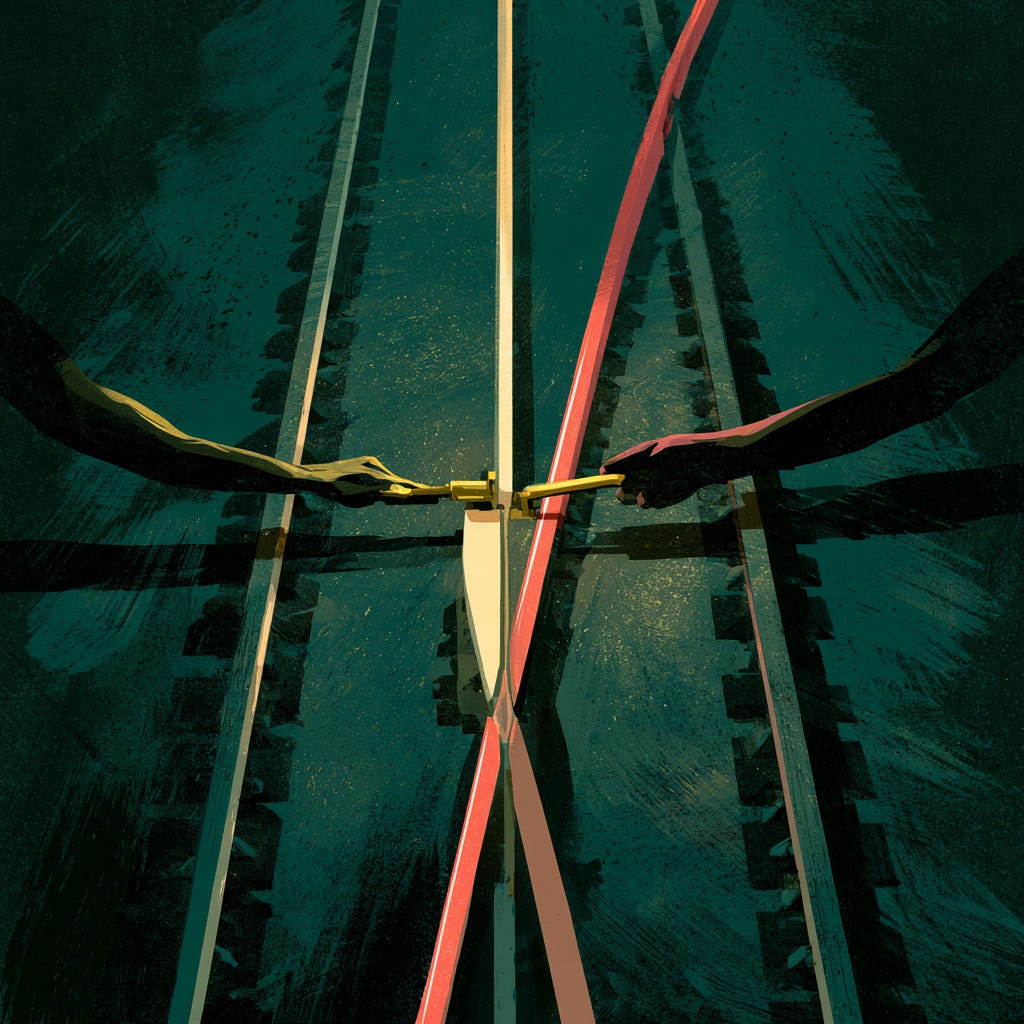
What I came to see is that there are really two lines running through the same country, and the trouble starts when you cannot tell which one you are on. One line carries the wine up through meaning: molecule, then language, then status. The other carries it up through quality: clean, then good, then genuinely rare. A passenger boards believing he is climbing the quality line and is quietly switched onto the status line somewhere in the dark, and pays the fare for one trip convinced he took the other. The weld is that switch in the track. And once you have seen it thrown, you start to catch it everywhere.
I have watched the false weld do its work at a dinner table, the violence of it disguised as taste. A good whisky, enjoyed, admired, half-finished. And then someone learns where it was made, somewhere unfashionable, somewhere the story says good whisky does not come from, and the glass is poured down the sink. Nothing in the liquid changed. The geography walked into the room and traveled backward through time and spoiled a thing the man had been enjoying a minute earlier. He did not taste a fault. He failed a map. This is not anecdotal, nor a moral indictment. There have been studies done to verify it. In a 2001 experiment at the University of Bordeaux, the same midrange Bordeaux, poured from one bottle labeled grand cru and another labeled table wine, was scored “excellent, complex, rounded, balanced” from the first and “weak, short, flat, simple, faulty” from the second. In another study that year, a white wine dyed red with an odorless dye was described, by fifty-four tasters, in the language of a red. And in a 2008 study, subjects who tasted wines in a functional MRI scanner rated the identical wine as more pleasant when it was framed at a higher price. The scan showed the brain’s pleasure response rise with the price, indicating that the cost altered the experience, not just the rating.
This train journey I experienced started with balance and harmony. It then transitioned into body and smoothness. Along the way I found a way to be inclusive of how differently mouths are built, because none of us are made equal there. Then the journey got interesting at the flavors, where the sommelier is a guide who hands you the olfactory keys, not a verdict, because flavor, in its truest sense, is deeply personal. That is where the wine gets interesting. So far, so good. But then the deceit and the pollution start. This is where people get alienated, or seduced onto an unsustainable path. It is like any relationship: fakery and deceit do not make it last. Fewer people are drinking wine. The losses at the boomer age who have swallowed the status quo are not being replaced and the people who would replace them are not being met with an open door. The wine industry, though, is doubling down on snobbery, blinded by a narrow vision.
What should be the weld on the track? Meritocracy and transparency. Like Europe is now mandating, wineries should list their ingredients and additives. Beyond that, they should be transparent about their farming certification, their yield, their vinification, where the fruit was sourced, and how the wine was stored. This gives a buyer a clear barometer to gauge earned quality and to see through unearned price.
And finally we arrive at the engine that drives it all. The essential ingredient that seduced our ancestors in the first place. It is the alcohol that is detected as warmth in our mouth, and eventually the one thing you cannot fake: drunkenness. In the ritual of this entire journey, the most honest thing is alcohol.
Now, coming back full circle, was my friend wrong in creating that criteria? Yes and no. He was wrong on the count of price. The chance of failure is much higher when someone uses price as a metric. The floor is not likely to be defined by price. Your chance of success is far better using the meritocratic barometer. Where he was right was the bottom shelf, because where a wine sits is a real tell. But even that only gets you to quality. What he did not mention is the flavor of wine. As we discussed through my journey, it is very personal. So know what he has emptied in the past, or the wine producer he prefers, before you buy wine for him, or for anyone for that matter. Because you cannot go by what you perceive or what the label says.
Sources
Morrot, G., Brochet, F., & Dubourdieu, D. (2001). The color of odors. Brain and Language, 79(2), 309–320. (The white wine dyed red, described by 54 tasters in the vocabulary of a red.)
Brochet, F., & Dubourdieu, D. (2001). Wine descriptive language supports cognitive specificity of chemical senses. University of Bordeaux, Faculty of Oenology. (The same wine described oppositely under grand cru and table-wine labels.)
Plassmann, H., O’Doherty, J., Shiv, B., & Rangel, A. (2008). Marketing actions can modulate neural representations of experienced pleasantness. Proceedings of the National Academy of Sciences, 105(3), 1050–1054.
Wine consumption figures: Wine Market Council, 2025 U.S. Wine Consumer Benchmark Segmentation Survey (share of legal-age adults drinking wine every two to three months fell from 34% to 29%; roughly 76 million consumers, about nine million fewer than 2023). U.S. wine sales down approximately 6% in 2024 (SipSource).
Fascinating perspective! Thank you
I can completely relate to your article. Excellent.